

During its operations, a business may have fully completed its tax filings and prepared its financial statements. However, this does not necessarily mean that its tax records fully meet the requirements of tax authorities in the event of a tax inspection or audit. Errors in the application of tax policies, tax declarations, accounting records, or document retention are often not detected immediately but accumulate over time, increasing tax risks as well as the risk of additional tax assessments and penalties.
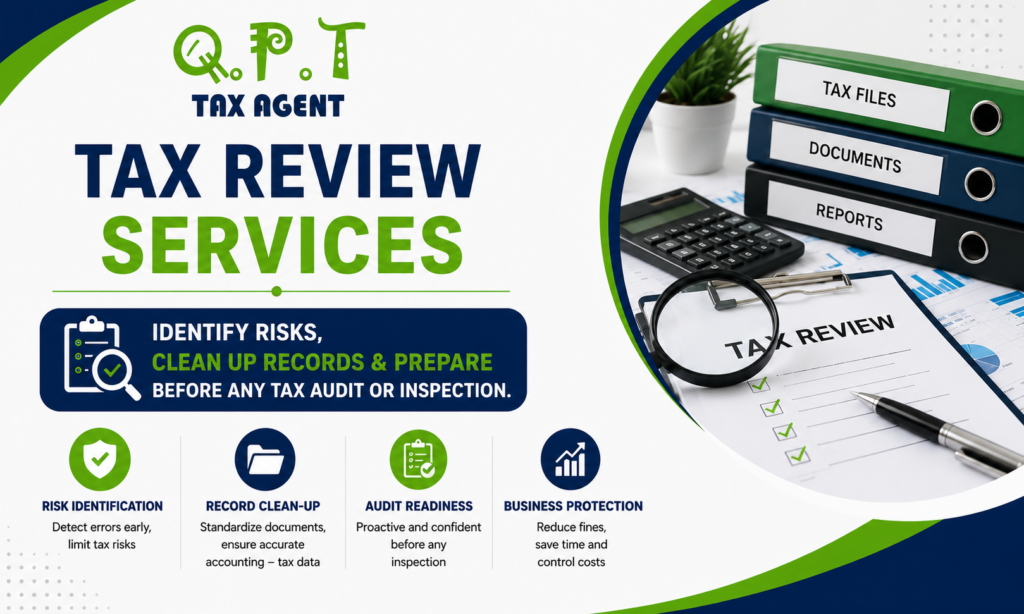
Tax review services help businesses conduct a comprehensive review of their tax records, supporting documents, and tax compliance practices. This allows businesses to identify potential risks, assess their level of compliance with applicable regulations, and receive appropriate recommendations before a tax inspection, audit, or tax finalization takes place.
What Are Tax Review Services?
Tax review services are professional services provided by tax specialists, tax advisory firms, or audit firms to assess and review the accuracy of a business’s tax practices and compliance with applicable tax regulations.
Through this process, businesses can ensure that their business activities and tax declaration and payment practices are lawful and complete, while minimizing potential risks and avoiding possible legal and tax-related issues.
Businesses That Should Consider Using Tax Review Services
- Businesses preparing for tax finalization;
- Businesses that have not reviewed their accounting records for many years;
- Businesses undergoing a change of chief accountant or key accounting personnel;
- Businesses with rapidly increasing revenue while their accounting system has not kept pace;
- Businesses with a large volume of invoices, supporting documents, contracts, receivables/payables, or inventory;
- Businesses that have previously received tax risk warnings or have indications of discrepancies in their data;
- Businesses wishing to clean up their records before obtaining financing, raising capital, transferring ownership, expanding, or restructuring;
- Businesses looking to upgrade their accounting system from basic transaction recording to proactive accounting and tax risk control.
In particular, this service is highly necessary for SMEs that have been operating for many years but have never undergone an independent, systematic, and comprehensive review.
Benefits of Tax Review Services
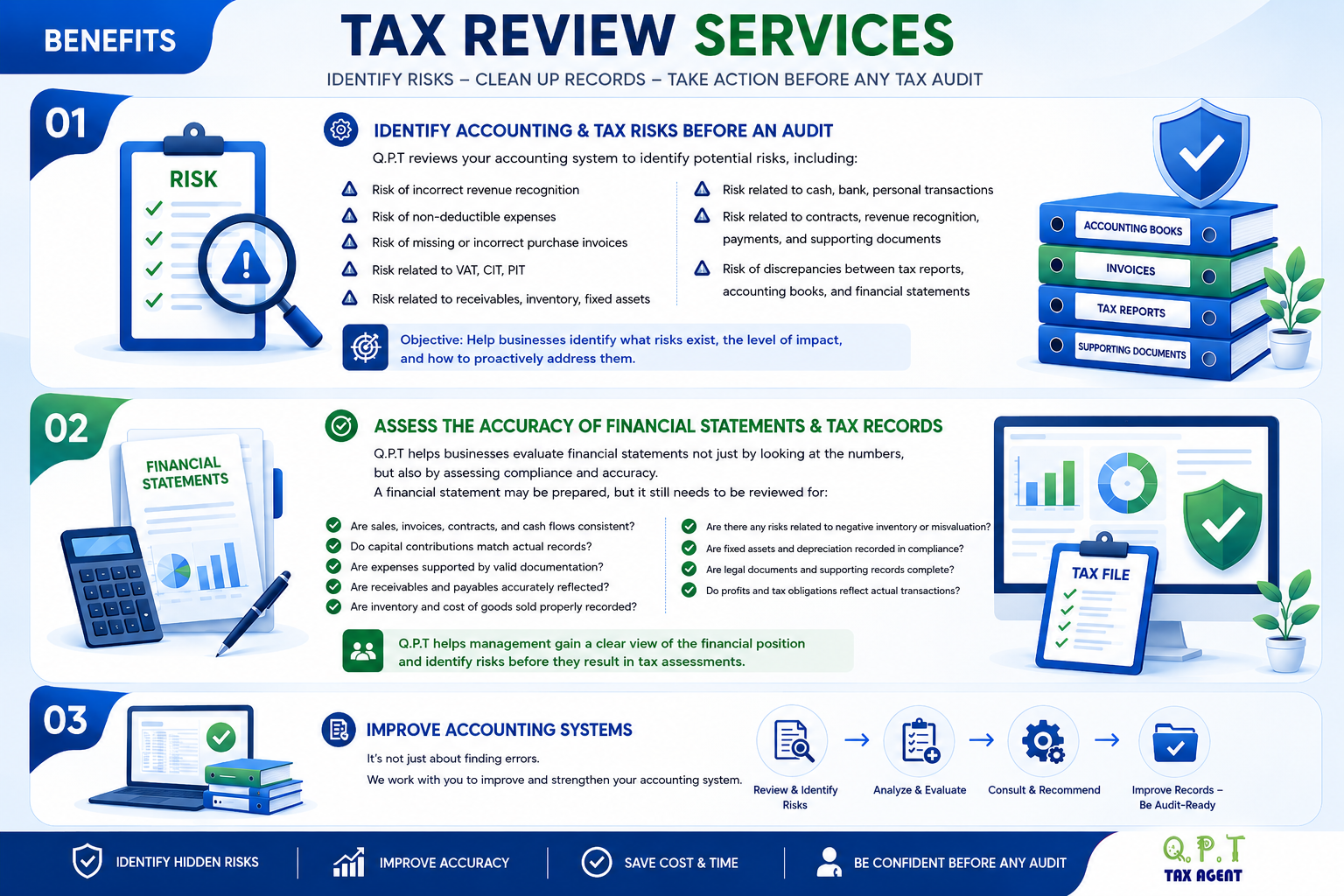
The service does not simply stop at checking whether the accounting records are complete. At Q.P.T Tax Agent, our tax review service goes deeper into the substance of each transaction:
- Has revenue been recognized at the correct time?
- Do expenses meet the requirements for tax deductibility?
- Do invoices, contracts, payments, and acceptance documents match?
- Do receivables and payables accurately reflect the actual situation?
- Are there any risks of negative inventory, incorrect cost of goods sold, or incorrect norms?
- Are there any risks related to VAT, Corporate Income Tax (CIT), Personal Income Tax (PIT), contractor tax, or e-invoices?
- Do the financial statements accurately reflect the actual financial position of the business?
- If the business is subject to a tax inspection, does it have sufficient supporting documents to explain and substantiate its figures?
Q.P.T helps businesses transform tax review from a “firefighting” activity carried out only when an inspection occurs into a proactive accounting and tax risk management mechanism.
Key Areas Covered in Q.P.T’s Tax Review
- Conduct meetings/interviews with the Company’s management and/or key personnel to understand the Company’s operating processes, strategies, objectives, business activities, and significant transactions.
- Review previous tax assessment records and correspondence between the Company and the tax authorities to identify areas that have been or may be subject to the tax authorities’ attention, if any.
- Review and perform sampling tests on relevant supporting documents, reporting procedures, and record-keeping practices, including but not limited to contracts, invoices, tax payment receipts, and other related documents.
- Review tax records to identify potential tax risks and recommend appropriate tax technical solutions to mitigate such risks.
- Identify significant areas of non-compliance, such as expense deductibility, and potential tax-related issues, including transfer pricing matters, utilization of tax losses, tax incentives, and the application and/or utilization of such incentives.
Corporate Income Tax (CIT) Review |
● Collect and review the Enterprise Registration Certificate and any updates thereto to determine the tax incentives applicable during the Review Period.
● Review the Company’s Financial Statements and CIT returns, including supplementary returns submitted to the tax authorities during the Review Period, and review adjustments made by the Company to identify any additional adjustments that may be required to comply with tax regulations; with particular focus on identifying non-deductible expenses and proposing further adjustments. ● Determine the Company’s CIT tax position, primarily based on: ● Review minutes, official letters, and correspondence between the Company and the tax authorities to identify areas that may be subject to the tax authorities’ attention. ● Perform a sample-based review of the calculation and filing of CIT during the Review Period to ensure the tax position is appropriate with respect to deductible expenses, revenue reporting, and timely submission of CIT filings. ● Assist the Company in calculating and preparing the CIT finalization return for the Review Period. ● Review and perform sample testing of supporting documents, reporting procedures, and record-keeping, including but not limited to contracts, invoices, and tax payment receipts, to assess the reasonableness and validity of each transaction and the Company’s tax treatment; with particular focus on the calculation of CIT in relation to prescribed raw material consumption norms. ● Identify CIT tax issues and potential concerns and provide recommendations for tax optimization, where applicable. |
Value Added Tax (VAT) Review |
● Review the Company’s Financial Statements and VAT returns, including supplementary returns submitted to the tax authorities during the Review Period, and review adjustments made by the Company to identify any additional adjustments that may be required to comply with tax regulations; with particular focus on identifying non-deductible expenses and proposing replacement adjustments.
● Review and examine, on a sample basis, the VAT returns and tax payment receipts submitted by the Company during the Review Period. ● Identify material VAT issues and provide recommendations to the Company regarding any necessary updates or supplementary VAT filings, where appropriate. |
Personal Income Tax (PIT) Review |
● Assist in the sample-based review of the PIT finalization returns, including detailed calculations and supporting documents provided by the Company during the Review Period.
● Review and assess the Company’s tax position in respect of taxable and non-taxable income. ● Identify PIT tax issues and potential concerns and recommend solutions, including supporting documentation, to support the Company’s tax position for acceptance by the tax authorities and to optimize PIT. |
Why Choose Q.P.T’s Accounting Bookkeeping Services?
With a team of experienced accounting and tax professionals who have a strong understanding of applicable laws and current accounting regulations, Q.P.T Tax Agent provides accounting bookkeeping services to support businesses in reviewing, completing, and standardizing their accounting records in a complete, accurate, and compliant manner.
The services are carried out based on data checking and reconciliation, completion of supporting documents and accounting records, contributing to consistency between accounting records, tax reports, and financial statements. At the same time, Q.P.T supports businesses in addressing accounting and tax-related issues and keeping up to date with relevant legal regulations, helping businesses improve management efficiency and better meet compliance requirements.