

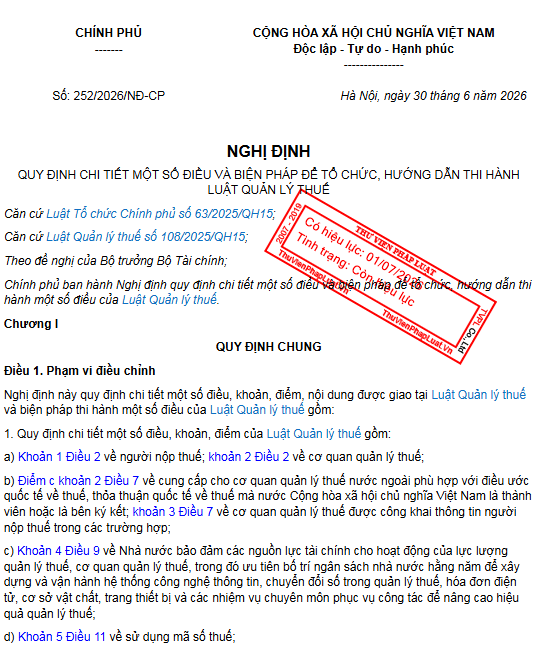
On 30 June 2026, the Government issued Decree No. 252/2026/ND-CP, providing detailed regulations and implementation measures for the Law on Tax Administration 2025.
The attachment includes the required documents: 252_2026_ND-CP_713086
Cases in Which Tax Authorities May Publicly Disclose Taxpayer Information from 1 July 2026
Under Decree No. 252/2026/ND-CP, tax authorities are authorized to publicly disclose taxpayer information in the following cases:
1. Taxpayers committing violations under Clause 3, Article 7 of the Law on Tax Administration 2025
These include taxpayers who:
- Commit acts of tax evasion or evade other statutory financial obligations;
- Fail to pay taxes, other state revenues, late payment interest, or administrative fines within the prescribed deadlines;
- Fail to voluntarily comply with tax payment obligations or administrative tax decisions more than 90 days after the due date, including cases where the guarantor also fails to fulfill the obligation;
- Commit tax law violations that adversely affect the tax rights and obligations of other organizations or individuals.
2. Failure to comply with requests issued by tax authorities
Taxpayer information may also be disclosed where the taxpayer:
- Refuses to provide information or supporting documents requested by the tax authority;
- Fails to comply with tax inspection decisions or other lawful requests of the tax authority;
- Fails to provide explanations regarding e-invoice risk alerts generated by the tax authority’s electronic invoice management system;
- Obstructs or resists tax or customs officials in the performance of their official duties;
- Fails to comply with administrative tax decisions while attempting to dissipate or transfer assets.
3. Taxpayer operational status
Tax authorities may publicly disclose information relating to taxpayers who:
- Are not operating at their registered business address;
- Have ceased operations but have not completed procedures for the deactivation of their tax identification number (TIN);
- Have temporarily suspended business operations.
4. Other cases prescribed by law
Taxpayer information may also be disclosed in other circumstances where disclosure is expressly required by applicable laws.
Information Subject to Public Disclosure
The information that may be published includes:
- Tax Identification Number (TIN);
- Taxpayer’s name;
- Registered business address;
- Reason for the public disclosure.
Depending on the specific circumstances, the tax authority may disclose additional information directly related to the taxpayer or the taxpayer’s tax obligations where necessary for tax administration in accordance with the law.
Special Provision for Taxpayers Not Operating at Their Registered Address
Where a taxpayer is determined not to be operating at the registered address, based on tax administration data and information provided by competent state authorities, the tax authority may also disclose limited information relating to:
- The owner of a private enterprise;
- The owner of a single-member limited liability company;
- A general partner;
- The legal representative of an enterprise;
- An individual conducting business;
- A household business owner.
The disclosed information includes:
- Full name; and
- The last four digits of the individual’s identification number (Citizen Identification Card or passport number), while all remaining digits must be masked or encrypted.
Effective Date
Decree No. 252/2026/ND-CP takes effect on 1 July 2026. It provides detailed regulations and implementation measures for the Law on Tax Administration 2025, including provisions governing the public disclosure of taxpayer information by tax authorities.