

From 1 July 2026, What Should Sellers Note When Issuing a New E-Invoice to Replace an Incorrectly Issued E-Invoice?
Effective 1 July 2026, sellers issuing a new electronic invoice (e-invoice) to replace an incorrectly issued e-invoice must comply with Clause 1, Article 10 of Circular No. 91/2026/TT-BTC, which provides guidance on handling issued e-invoices.
1. Cases Where a Replacement E-Invoice May Be Issued
A seller may choose either to adjust or issue a new replacement e-invoice if the original e-invoice contains errors relating to:
- Tax Identification Number (TIN);
- Description of goods or services;
- Goods that do not match the actual specifications or quality;
- Invoice amount;
- VAT rate;
- VAT amount; or
- Other mandatory invoice information.
However, if the errors only relate to the buyer’s name, address, the amount written in words, or other information that does not affect the TIN, invoice amount, VAT rate, VAT amount, or the goods/services stated on the invoice, the above replacement procedure does not apply.
2. Mandatory Statement on the Replacement E-Invoice
The new replacement e-invoice must include the following statement:
“Replacement for Invoice Form No. …, Series …, Invoice No. …, dated …/…/….”
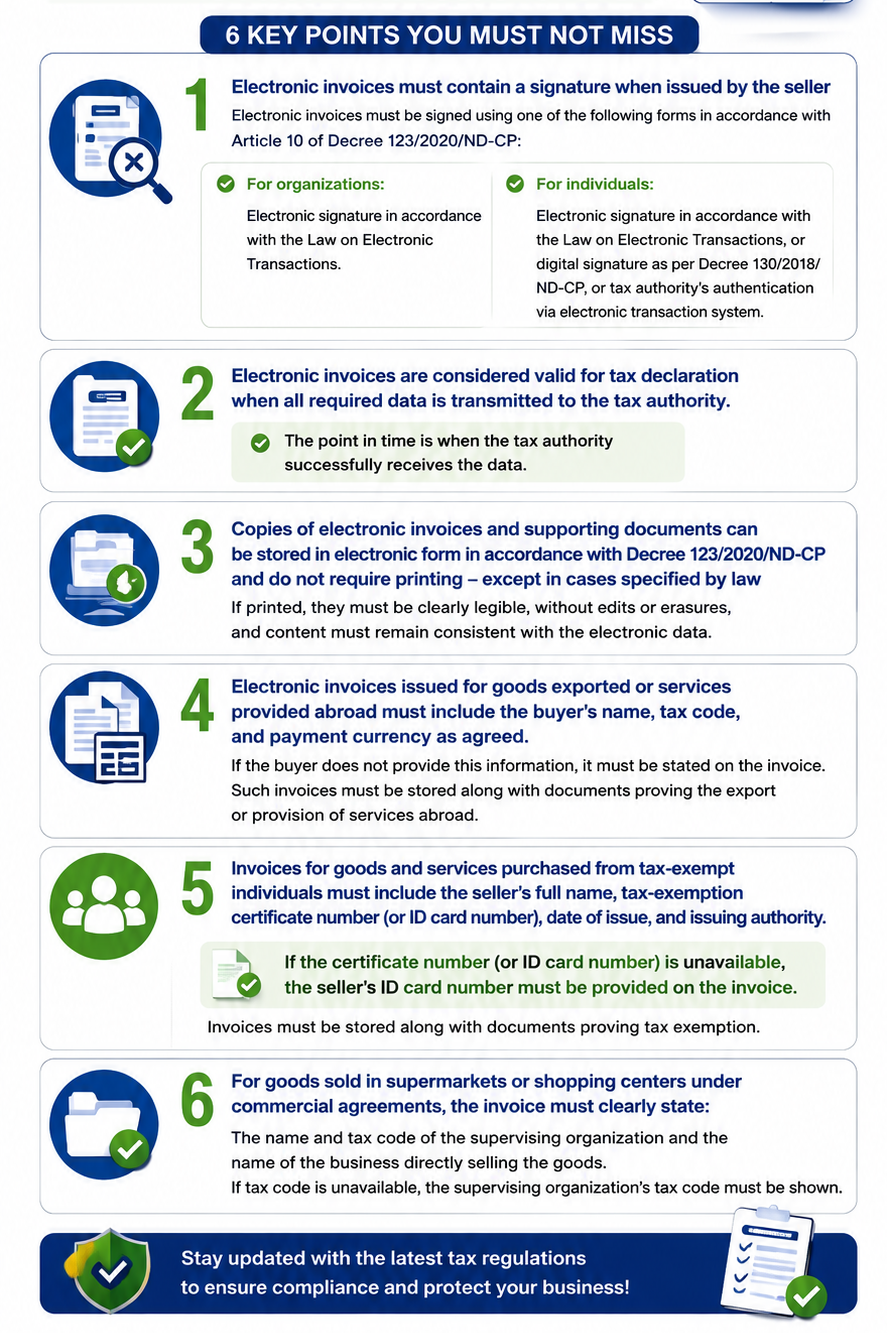
3. Digital Signature and Invoice Submission
After issuing the adjusted or replacement e-invoice, the seller must apply a digital signature and:
- Send it directly to the buyer if using e-invoices without a tax authority’s authentication code; or
- Submit it to the tax authority for authentication before sending it to the buyer if using authenticated e-invoices.
4. One Replacement Invoice for Multiple Incorrect Invoices
If, within the same month, multiple invoices issued to the same buyer contain identical errors regarding:
- Buyer information;
- Goods or services;
- Unit price;
- Quantity; or
- VAT rate,
the seller may issue one adjustment invoice or one replacement invoice covering all incorrect invoices issued during that month.
In this case, the seller must attach Form No. 01/BK-ĐCTT in Appendix III of Circular No. 91/2026/TT-BTC, listing all affected e-invoices.
5. Agreement Before Issuing an Adjustment or Replacement Invoice
Before adjusting or replacing an incorrect e-invoice:
- If the buyer is an enterprise, organization, household business, or individual business operator, both parties must prepare a written agreement clearly specifying the incorrect information.
- If the buyer is an individual consumer, the seller must notify the buyer directly or publish the notice on the seller’s website (if any).
The seller is responsible for retaining the written agreement and presenting it to the tax authority or other competent authorities upon request.
6. Cases Where a Written Agreement Is Not Required
A written agreement is not mandatory in the following cases:
- Electronic invoice data is transmitted through the Summary of E-Invoice Data as prescribed in Point a.1, Clause 3, Article 16 of Decree No. 254/2026/ND-CP.
- Transaction data is transmitted through the Detailed Transaction Information Statement under Point a.2, Clause 3, Article 16 of Decree No. 254/2026/ND-CP.
- Transactions involving the sale of goods via e-commerce platforms or other digital platforms.
Key Takeaway
From 1 July 2026, sellers issuing replacement e-invoices must ensure compliance with the procedures prescribed in Circular No. 91/2026/TT-BTC, including the required invoice wording, digital signature requirements, buyer notification procedures, and supporting documentation where applicable. Proper compliance helps minimize tax risks and ensures the legal validity of replacement e-invoices.
Types of Electronic Invoices Under Decree No. 254/2026/ND-CP Effective from 1 July 2026
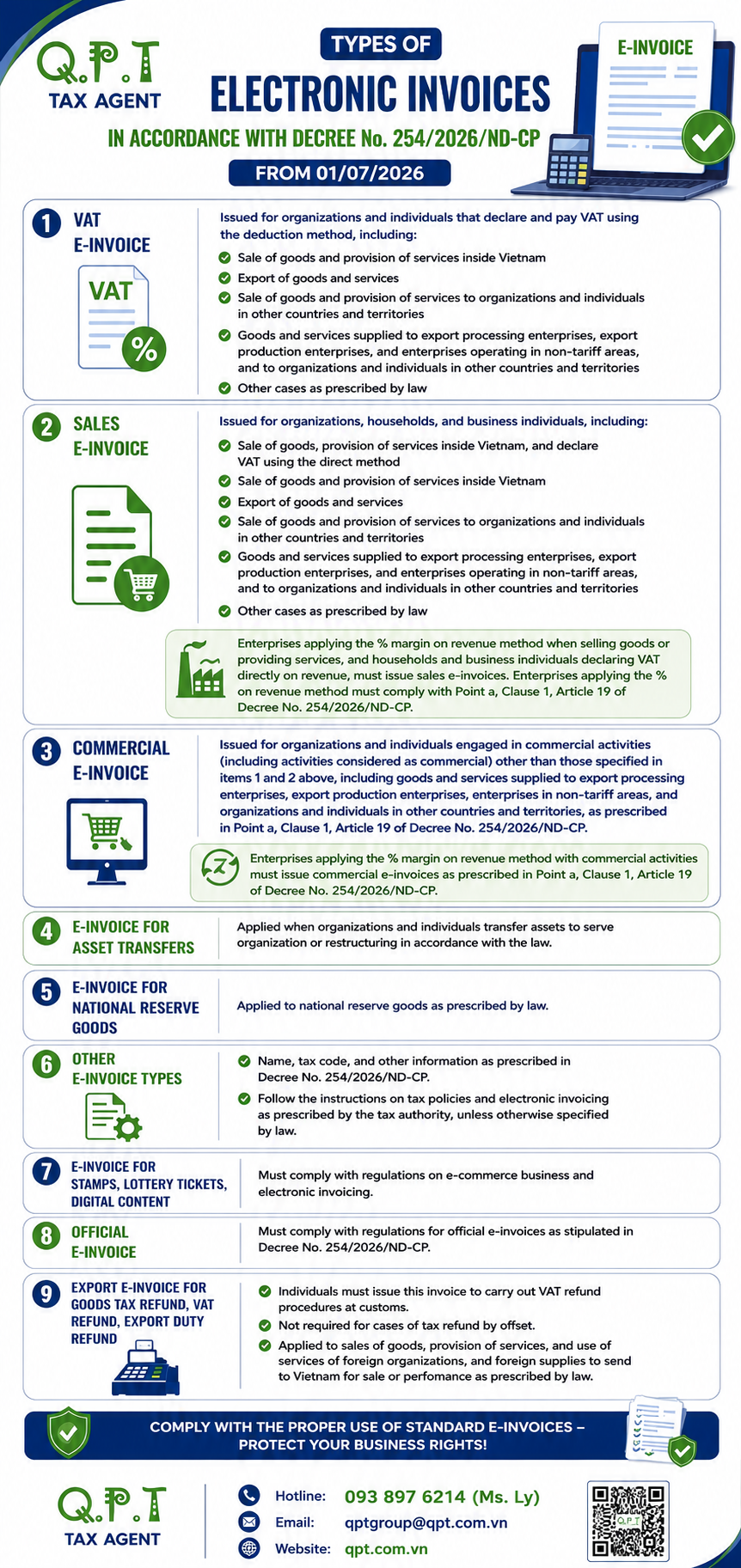
Pursuant to Article 8 of Decree No. 254/2026/ND-CP, the following types of electronic invoices (e-invoices) apply from 1 July 2026:
1. Value-Added Tax (VAT) Invoice
A VAT invoice is used by organizations that declare VAT under the credit (deduction) method for the following activities:
- Sale of goods and provision of services within Vietnam;
- International transportation services;
- Supplies to non-tariff zones and transactions treated as exports;
- Export of goods and provision of services overseas;
- E-commerce, digital platform-based business activities, and other services provided by foreign suppliers without a permanent establishment in Vietnam.
2. Sales Invoice
A sales invoice is used by organizations, household businesses, and individual business operators in the following cases:
Organizations, household businesses, and individuals applying the direct VAT calculation method for:
- Sale of goods and provision of services within Vietnam;
- International transportation services;
- Supplies to non-tariff zones and transactions treated as exports;
- Export of goods and provision of services overseas.
Organizations and individuals operating in non-tariff zones
When selling goods or providing services:
- Into the domestic market;
- Between entities within non-tariff zones; or
- For export,
the invoice must clearly state:
“For Organizations and Individuals in Non-Tariff Zones.”
Export processing enterprises (EPEs) carrying out business activities other than export processing shall use:
- Sales invoices if applying the direct VAT method; or
- VAT invoices if applying the credit (deduction) method.
3. Electronic Commercial Invoice
An electronic commercial invoice is used by organizations, household businesses, and individual business operators exporting goods or providing services overseas, provided they are capable of transmitting commercial invoice data electronically to the tax authority.
The electronic commercial invoice must:
- Comply with the content requirements prescribed in Article 10 of Decree No. 254/2026/ND-CP; and
- Follow the prescribed standard data format.
If the exporter cannot electronically transmit commercial invoice data to the tax authority, they may instead issue either:
- An electronic VAT invoice; or
- An electronic sales invoice.
4. Electronic Invoice for the Sale of Public Assets
This invoice is used for the sale or transfer of state-owned public assets in accordance with the regulations governing public asset management and use.
5. Electronic Invoice for the Sale of National Reserve Goods
This invoice is used when agencies and units within the National Reserve System sell national reserve goods in accordance with applicable laws.
6. Other Types of Invoices
These include:
- Electronic stamps, tickets, and cards that comply with the prescribed standard data format and content requirements; and
- Air freight receipts, international freight charge documents, and banking service fee documents, provided their format and contents comply with international practices and relevant legal regulations.
7. Documents Managed as Invoices
The following documents are registered, issued, and managed in the same manner as invoices:
- Internal delivery notes for goods transported between business locations; and
- Warehouse release notes for goods delivered to sales agents.
8. Invoice Templates
The Ministry of Finance will issue sample formats of the various invoice types for reference by the entities specified in Article 2 of Decree No. 254/2026/ND-CP during implementation.
9. E-Invoices Generated from Cash Registers Connected to the Tax Authority
Electronic invoices generated from cash registers connected to the tax authority’s information system must satisfy the following principles:
- They must be clearly identifiable as invoices generated from a cash register connected to the tax authority.
- A digital signature is not mandatory.
- Expenses supported by these invoices (verified through the Tax Administration Information System) are regarded as supported by valid invoices and lawful documentation for tax purposes.
Key Takeaway
From 1 July 2026, Decree No. 254/2026/ND-CP officially recognizes multiple categories of electronic invoices, including VAT invoices, sales invoices, electronic commercial invoices, invoices for public assets, invoices for national reserve goods, and cash register-generated e-invoices, each designed for specific taxpayers and business activities in accordance with Vietnam’s tax regulations.