


(Effective from July 1, 2026, under Decree No. 254/2026/ND-CP)
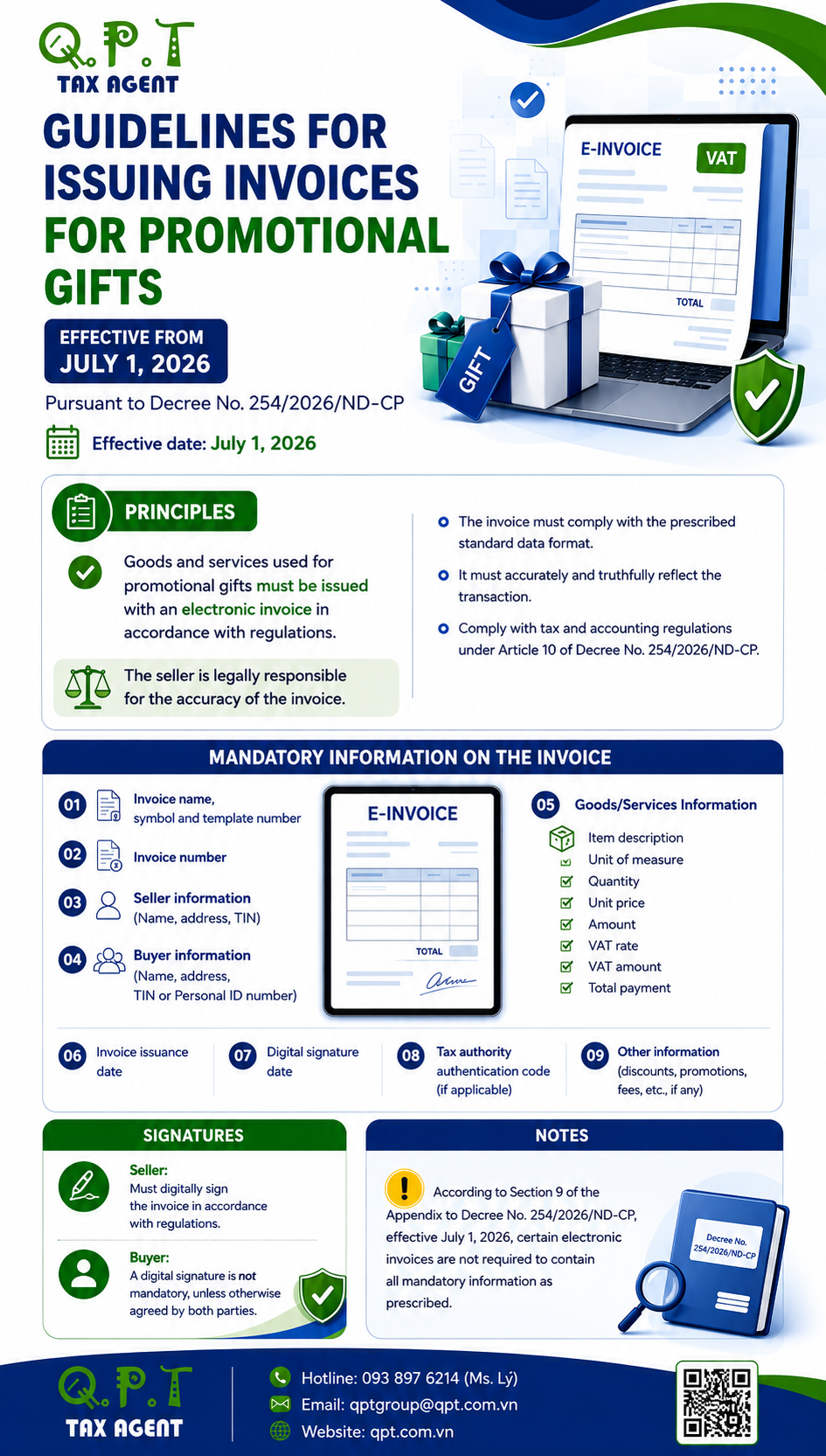
Under Decree No. 254/2026/ND-CP, effective July 1, 2026, businesses that provide goods or services as promotional items, gifts, or donations are required to issue electronic invoices in accordance with the applicable regulations.
1. General Principles for Issuing Invoices
Goods and services provided as promotional items, gifts, or donations must be supported by an electronic invoice.
The invoice must:
- Comply with the prescribed standard electronic data format.
- Accurately and truthfully reflect the actual business transaction.
- Comply with tax, accounting regulations, and Article 10 of Decree No. 254/2026/ND-CP.
The seller is legally responsible for the accuracy of all information stated on the invoice.
2. Mandatory Invoice Contents
An electronic invoice for promotional, gifted, or donated goods/services must include the following information:
(1) Invoice information
- Invoice name
- Invoice symbol
- Invoice form number
(2) Invoice number
(3) Seller information
- Seller’s name
- Address
- Tax Identification Number (TIN)
(4) Buyer information
- Buyer’s name
- Address
- Tax Identification Number (TIN) or Identification Number (if applicable)
(5) Goods/Services information
- Name of goods or services
- Unit of measurement
- Quantity
- Unit price
- Amount before VAT
- VAT rate
- VAT amount
- Total payment amount
(6) Invoice issuance date
(7) Digital signature date
(8) Tax authority authentication code
(Applicable to authenticated e-invoices.)
(9) Other information (if any)
Such as:
- Discounts
- Sales promotions
- Fees
- Charges
- Other additional information as prescribed by law
3. Digital Signatures on the Invoice
Seller
The seller is required to digitally sign the electronic invoice in accordance with the regulations.
Buyer
The buyer’s digital signature is not mandatory, unless otherwise agreed upon by both parties.
4. Cases Where Certain Invoice Information Is Not Mandatory
According to Section 9 of the Appendix to Decree No. 254/2026/ND-CP, effective July 1, 2026, certain electronic invoices are permitted to omit some mandatory information as specifically provided by law.
5. Important Notes When Issuing Invoices for Promotional, Gifted, or Donated Goods
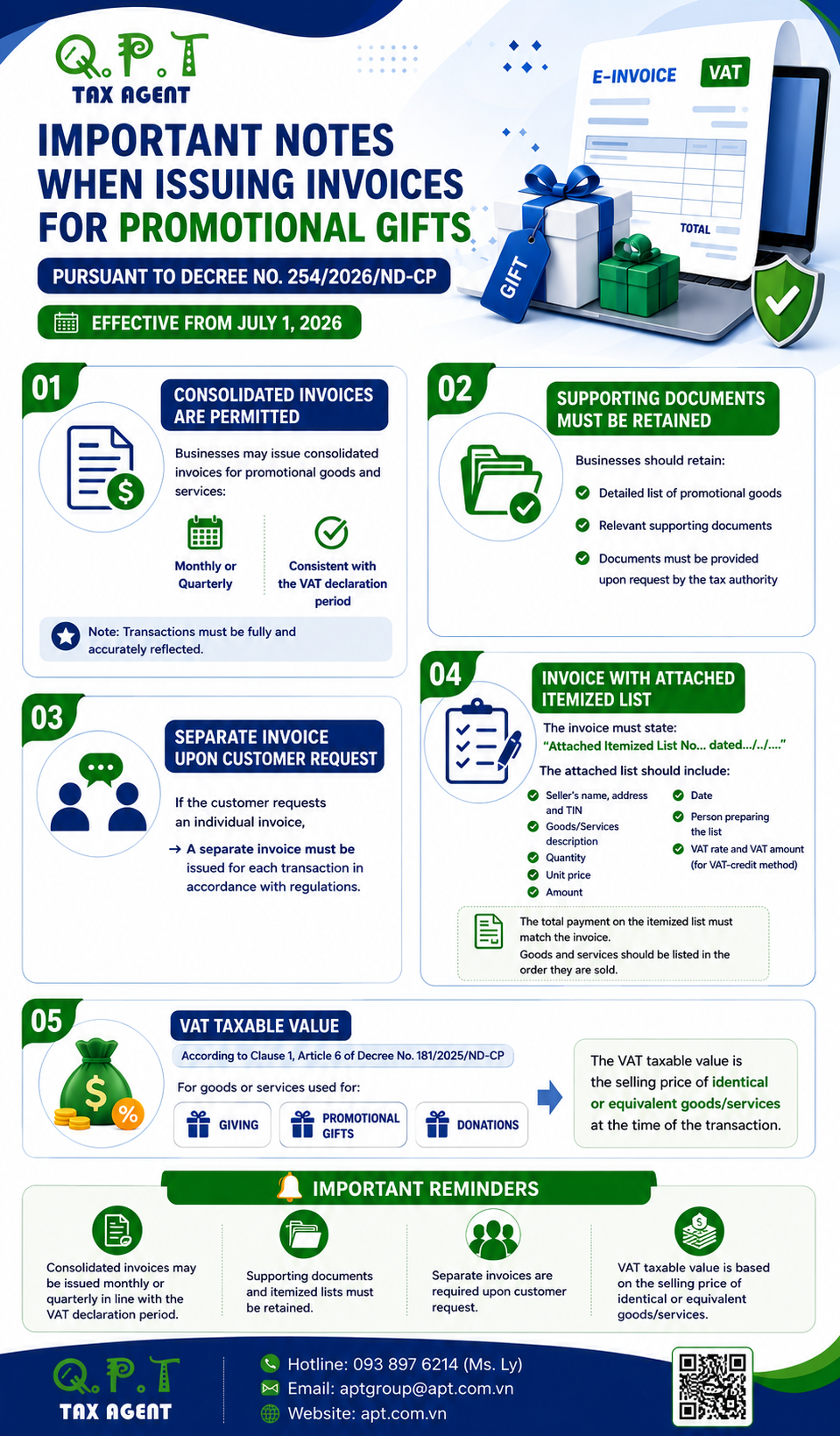
Consolidated invoices are permitted
Businesses may issue consolidated invoices for promotional, gifted, or donated goods and services on a:
- Monthly basis; or
- Quarterly basis,
provided that such issuance is consistent with the applicable VAT declaration period.
All transactions must still be recorded completely and accurately.
Supporting documents must be retained
Businesses are required to retain:
- Detailed lists of gifted or donated goods;
- Relevant supporting documents and records;
- Documentation for submission to the tax authority upon request.
Separate invoices upon customer request
If requested by the customer, the business must issue a separate invoice for each individual transaction in accordance with legal requirements.
Invoices accompanied by an attachment (Itemized List)
Where an attachment is used, the invoice must clearly state:
“Attached to Itemized List No. … dated …/…/….”
The attachment may include:
- Seller’s name, address, and TIN
- Description of goods/services
- Quantity
- Unit price
- Amount
- Date of preparation
- Name of the preparer
- VAT rate and VAT amount (for businesses applying the VAT credit method)
In addition:
- The total amount shown on the attachment must match the total amount stated on the VAT invoice.
- Goods and services listed in the attachment should be arranged in chronological order based on the date of sale.
VAT Taxable Price
According to Clause 1, Article 6 of Decree No. 181/2025/ND-CP, for goods or services used as:
- Promotional items;
- Gifts; or
- Donations,
the VAT taxable price is the selling price of identical or equivalent goods or services at the time the transaction occurs.
6. Time of Invoice Issuance for Promotional, Gifted, or Donated Goods
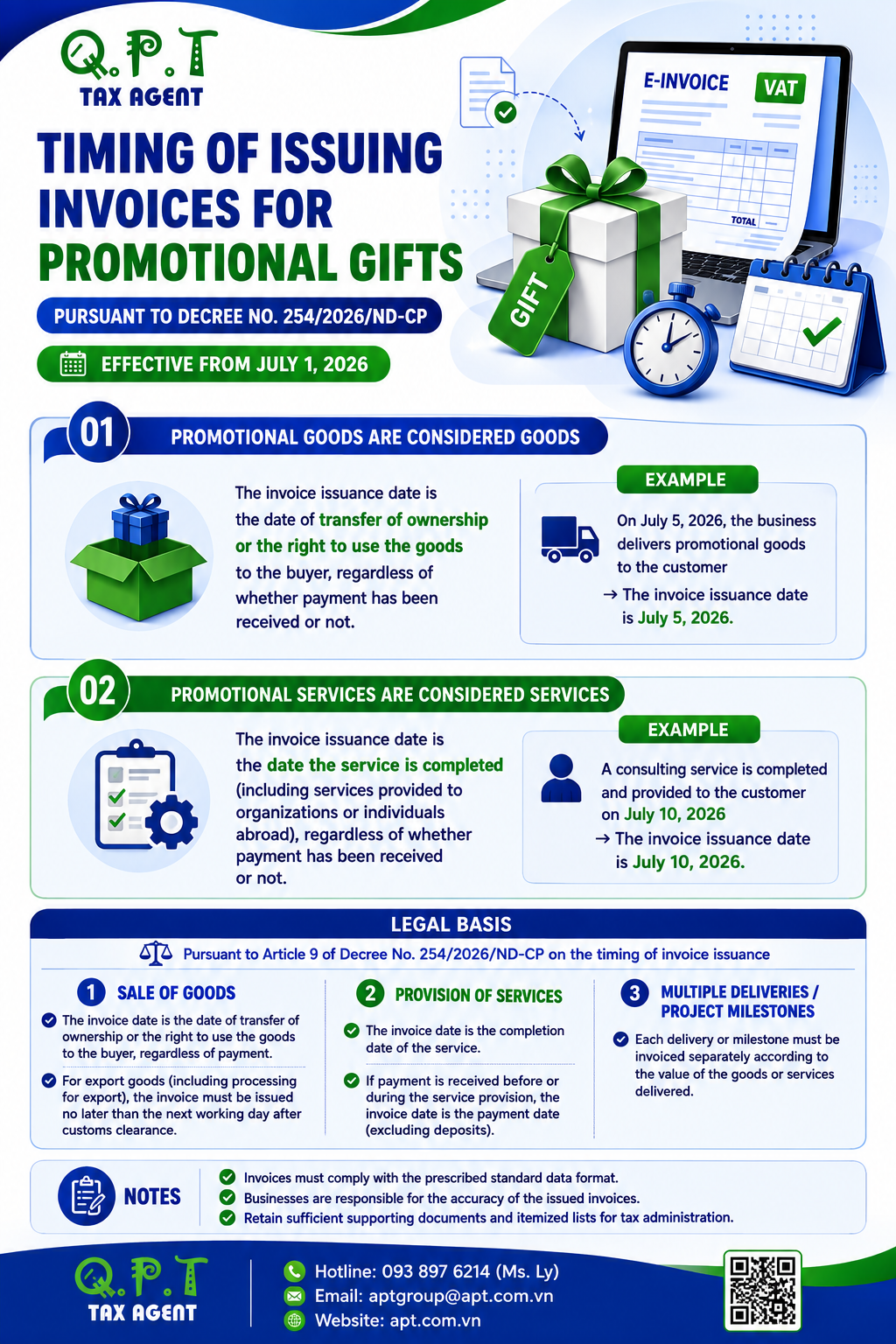
Goods
The invoice must be issued at the time ownership or the right to use the goods is transferred to the recipient, regardless of whether payment has been received.
Example
If a business delivers gifted goods to a customer on July 5, 2026, the invoice must also be issued on July 5, 2026.
Services
The invoice must be issued upon completion of the service, including services provided to foreign organizations or individuals, regardless of whether payment has been received.
Example
If a consulting service provided as a complimentary gift is completed on July 10, 2026, the invoice must be issued on July 10, 2026.
7. Legal Basis for Invoice Issuance Timing
According to Article 9 of Decree No. 254/2026/ND-CP:
Sale of goods
The invoice issuance date is the date on which ownership or the right to use the goods is transferred to the buyer, regardless of payment status.
For exported goods (including processed exports), the invoice must be issued no later than the next working day after customs clearance.
Provision of services
The invoice issuance date is the date the service is completed, regardless of whether payment has been received.
If payment is collected before or during service provision, the invoice must be issued at the time payment is received, excluding deposits.
Multiple deliveries or phased handovers
For contracts involving multiple deliveries or phased completion, an invoice must be issued for each delivered batch or completed portion corresponding to the value of goods or services provided.
8. Key Takeaways
Businesses should keep in mind that:
- Consolidated invoices may be issued monthly or quarterly if consistent with the VAT filing period.
- All supporting schedules and documentation must be retained.
- Separate invoices must be issued whenever requested by customers.
- The VAT taxable price is based on the selling price of identical or equivalent goods or services at the time the transaction occurs.
- Sellers are responsible for the accuracy of invoice information and must properly maintain all supporting records for tax administration purposes.
Below is an infographic summarizing the above content: