

Can Household Businesses Defer the Payment of PIT and VAT for July 2026? What Are the Specific Regulations?
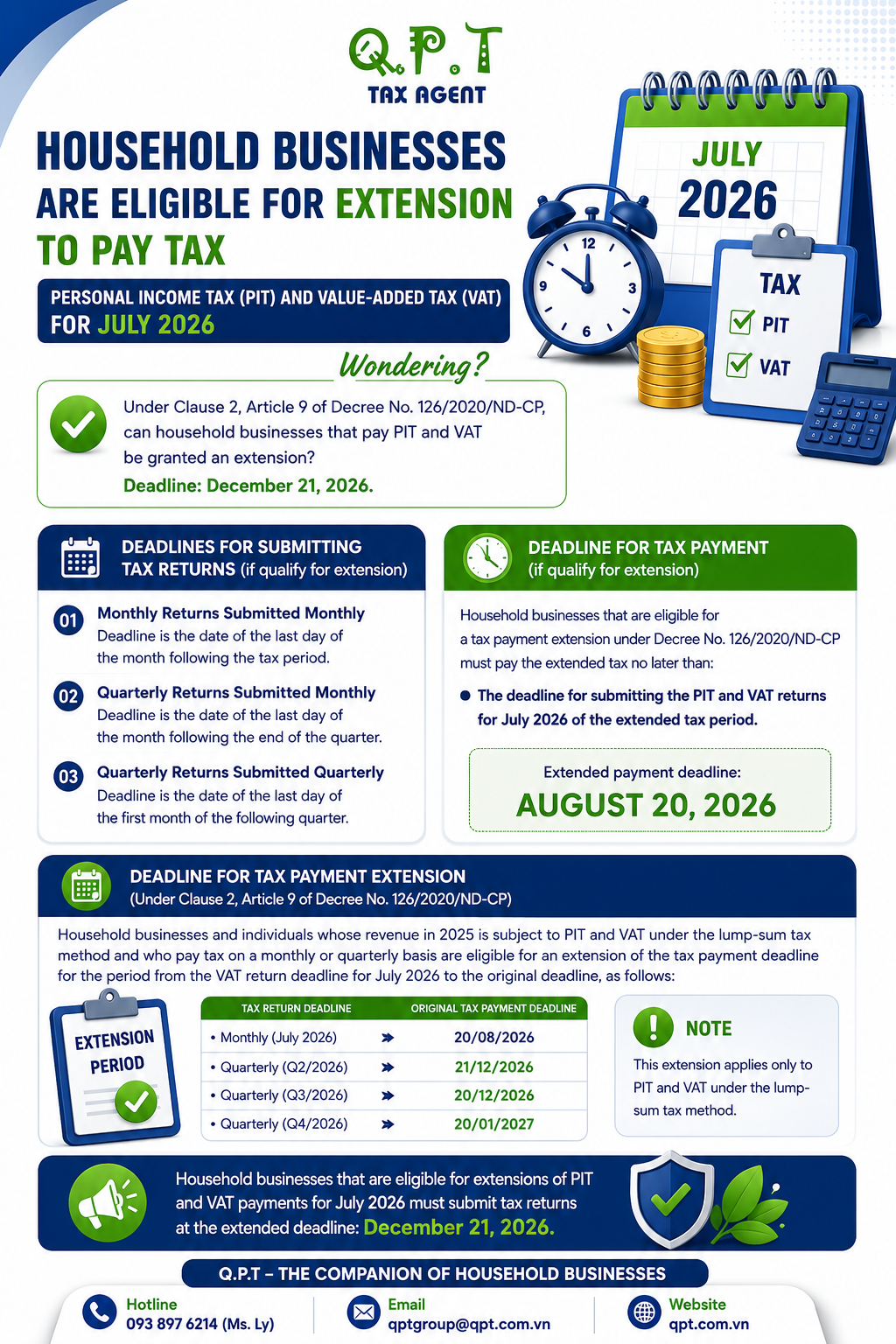
Yes. Pursuant to Article 2 of Decree No. 245/2026/ND-CP, the Government introduced a policy to extend the payment deadlines for Value-Added Tax (VAT), Corporate Income Tax (CIT), Personal Income Tax (PIT), and Land Rental Fees in 2026 to support taxpayers. Accordingly, eligible household businesses and individual business operators are entitled to defer the payment of VAT and PIT for the July 2026 tax period until 21 December 2026.
According to Clause 2, Article 10 of Decree No. 252/2026/ND-CP, for taxes declared on a monthly basis, the tax return must be submitted no later than the 20th day of the month following the month in which the tax liability arises. In addition, Point (a), Clause 1, Article 14 of the Law on Tax Administration 2025 stipulates that, where taxpayers self-assess their taxes, the tax payment deadline is the same as the deadline for submitting the tax return.
Accordingly, under the general regulations, the payment deadline for VAT and PIT for the July 2026 tax period would normally be 20 August 2026.
However, to facilitate business operations, Article 2 of Decree No. 245/2026/ND-CP allows an extension of up to five (05) months for the payment of VAT (including allocated VAT and VAT payable on each taxable transaction) and PIT applicable to household businesses and individual business operators.
The extended payment deadlines are as follows:
- May 2026 tax period: no later than 20 November 2026.
- June, July, August, and September 2026 tax periods: no later than 21 December 2026.
- Quarter II of 2026: no later than 02 November 2026.
- Quarter III of 2026: no later than 30 December 2026.
It should be noted that this policy only extends the deadline for tax payment and does not extend the deadline for filing tax returns. Therefore, taxpayers are still required to submit their tax declarations within the statutory deadlines prescribed by the Law on Tax Administration and its guiding regulations.
Important Note: The extension policy does not apply to import VAT.
Conclusion
Eligible household businesses under Decree No. 245/2026/ND-CP are entitled to defer the payment of VAT and PIT for the July 2026 tax period until 21 December 2026, instead of the normal deadline of 20 August 2026. However, tax returns must still be filed on time, as only the tax payment deadline is extended under the Government’s policy.
In What Cases Can Taxpayers Obtain a Tax Payment Extension?
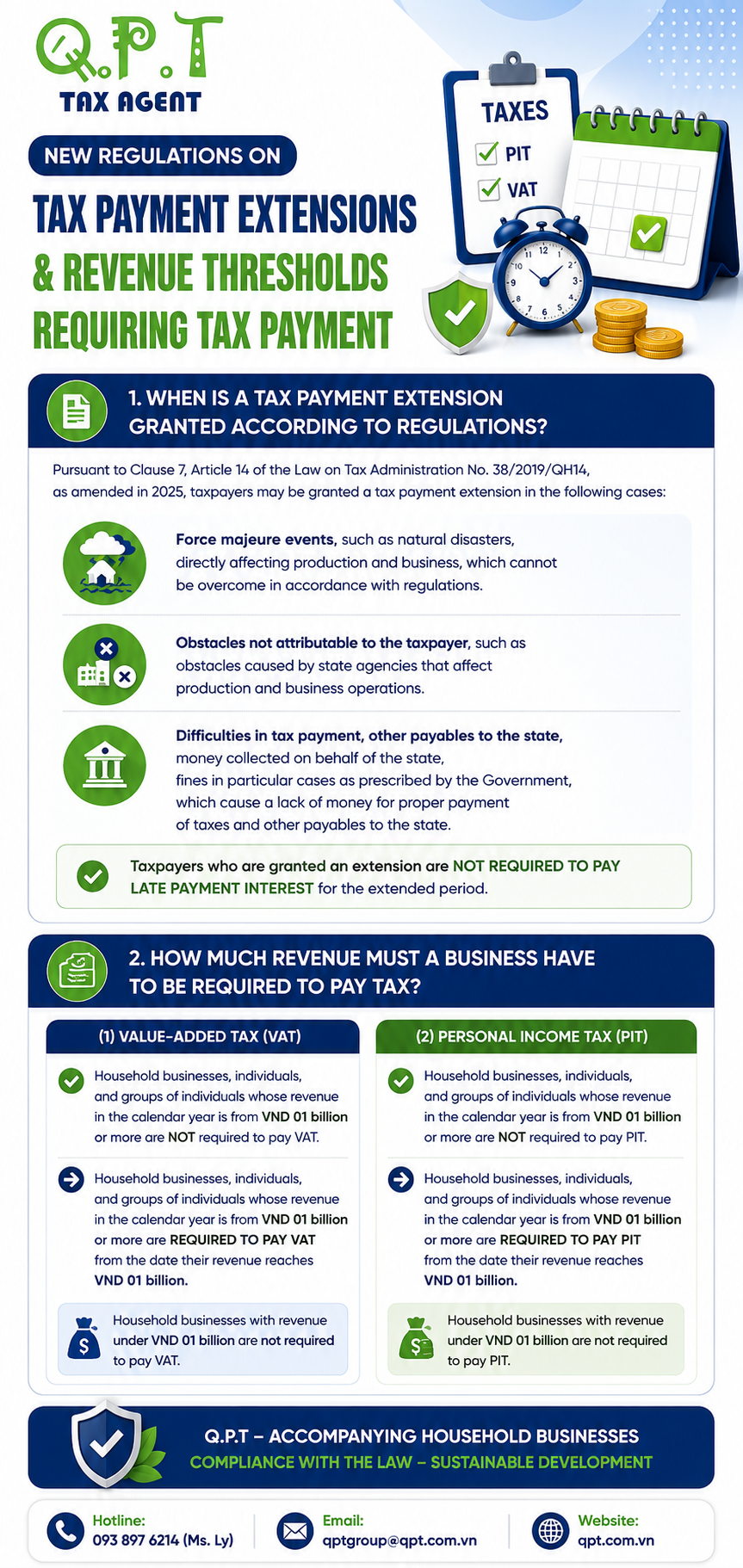
Pursuant to Clause 7, Article 14 of the Law on Tax Administration 2025, taxpayers may be granted an extension for the payment of taxes, other state budget revenues, late payment interest, and administrative fines in the following circumstances:
1. Material Damage Caused by Force Majeure
Taxpayers suffer material losses that directly affect their production or business activities due to force majeure events as prescribed by law.
2. Business Relocation Required by Competent Authorities
Taxpayers are required to suspend operations because they must relocate their production or business premises at the request of a competent state authority, resulting in adverse impacts on their business performance.
3. Special Cases Prescribed by the Government
Taxpayers may also be granted an extension for the payment of taxes, other state budget revenues, late payment interest, and administrative fines in special circumstances as stipulated by the Government.
Such extensions must not affect the State budget revenue estimates approved by the National Assembly.
Important Note
During the approved extension period, taxpayers are not required to pay late payment interest on the deferred tax amounts.
What Annual Revenue Threshold Requires Household Businesses to Pay Taxes?
1. Value-Added Tax (VAT)
Pursuant to Article 3 of Decree No. 68/2026/ND-CP, as amended by Clause 1, Article 1 of Decree No. 141/2026/ND-CP:
- Household businesses and individual business operators with annual revenue of VND 1 billion or less are not subject to VAT.
- Household businesses and individual business operators with annual revenue exceeding VND 1 billion are subject to VAT and must calculate VAT using the direct method based on revenue, applying the prescribed percentage rates in accordance with the Law on Value-Added Tax No. 48/2024/QH15 and its guiding regulations.
Conclusion
A household business is required to pay VAT only if its annual revenue exceeds VND 1 billion.
2. Personal Income Tax (PIT)
Pursuant to Article 4 of Decree No. 68/2026/ND-CP, as amended by Clause 1, Article 1 of Decree No. 141/2026/ND-CP:
Resident individuals engaged in business activities—including individuals who register household businesses or those authorized by household members to act as the household business representative—with annual revenue of VND 1 billion or less are not required to pay Personal Income Tax (PIT).
Conclusion
Household businesses and individual business operators are required to pay PIT only when their annual revenue exceeds VND 1 billion.